Remote control (RC) cars are more than just exciting toys. While they are often chosen for fun and entertainment, they also play an important role in supporting children’s physical and cognitive development. From improving coordination to strengthening focus, RC cars offer valuable developmental benefits that many parents may not immediately recognize.
In this article, we explore how RC cars help enhance motor skills, concentration, problem-solving abilities, and overall growth in children.
What Are Motor Skills and Why Do They Matter?
Motor skills are movements and actions of the muscles. They are divided into two main types:
- Fine motor skills – small movements involving hands and fingers
- Gross motor skills – larger movements involving arms, legs, and full body coordination
Strong motor skills are essential for everyday activities such as writing, sports, balance, and even basic tasks like tying shoes. Toys that encourage movement and control help children strengthen these abilities in a natural and enjoyable way.
RC cars are especially effective because they require both physical coordination and mental focus.
1. Improving Hand-Eye Coordination
One of the primary benefits of RC cars is the improvement of hand-eye coordination.
When a child operates an RC car, they must:
- Observe the car’s movement
- Adjust the controller accordingly
- Predict direction and speed
- Avoid obstacles
This continuous coordination between vision and hand movement strengthens neural connections in the brain. Over time, children become quicker and more precise in their reactions.
Hand-eye coordination is essential for sports, writing, drawing, and many daily activities.
2. Strengthening Fine Motor Skills
Operating a remote controller requires controlled finger and hand movements. Children must press buttons, steer with precision, and manage acceleration carefully.
These small, repetitive movements help:
- Improve finger dexterity
- Increase grip strength
- Enhance control over small muscle movements
Fine motor development is particularly important during early childhood, as it supports tasks such as handwriting and detailed craft work.
3. Enhancing Gross Motor Skills
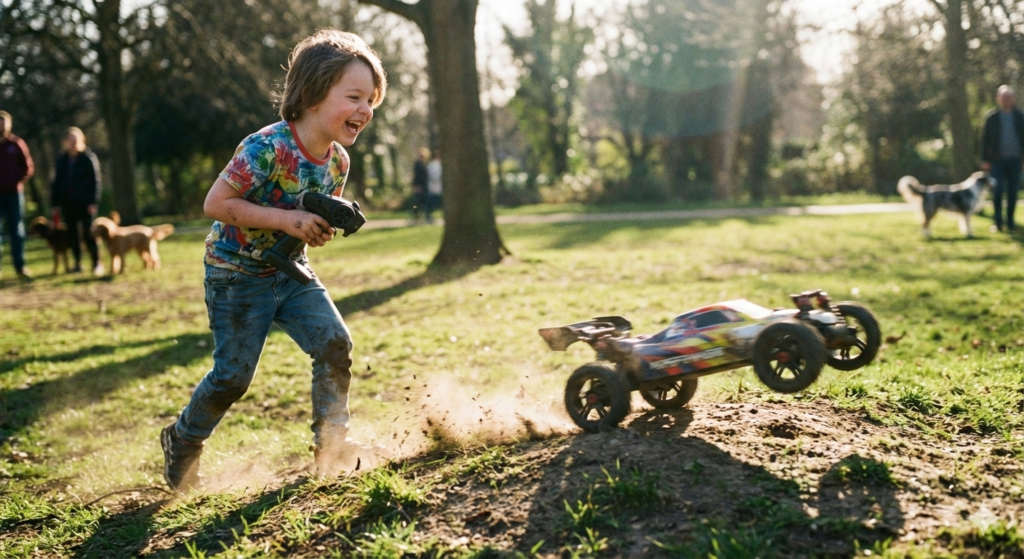
When children play with RC cars outdoors, they naturally engage their larger muscle groups. Running after the car, bending, adjusting obstacles, or navigating terrain all contribute to gross motor development.
Outdoor RC play can:
- Improve balance
- Encourage physical activity
- Develop spatial awareness
- Increase overall coordination
Unlike passive screen time, RC cars motivate children to move and stay active.
4. Developing Focus and Concentration
Controlling an RC car requires attention. Children must stay focused to avoid crashes and guide the car successfully.
This helps develop:
- Sustained attention
- Quick decision-making
- Reaction speed
- Problem-solving skills
The need to concentrate on direction, speed, and obstacles encourages mental engagement and strengthens cognitive control.
5. Encouraging Problem-Solving Skills
RC cars often present small challenges. The car may flip over, get stuck, or require adjustments in speed to navigate terrain.
When this happens, children learn to:
- Analyze the situation
- Experiment with solutions
- Adjust their strategy
- Try again after failure
These experiences build resilience and teach children that mistakes are part of learning. This mindset is essential for academic and personal success later in life.
6. Building Patience and Control
Mastering an RC car takes practice. At first, children may struggle with steering or speed control. Over time, they learn to slow down, think ahead, and plan movements carefully.
This process strengthens:
- Self-control
- Patience
- Emotional regulation
Learning to manage excitement while maintaining control is a valuable life skill.
7. Supporting Social Skills and Team Play
RC cars can also promote social interaction. When children play together, they may:
- Organize races
- Create obstacle courses
- Share strategies
- Take turns controlling vehicles
Group play encourages communication, cooperation, and friendly competition. It also helps children build confidence in social settings.
8. Boosting Confidence Through Skill Mastery
As children improve their ability to control the RC car, they experience a sense of achievement. Successfully navigating obstacles or completing a race builds self-esteem.
Confidence grows when children:
- See progress in their skills
- Overcome challenges
- Receive positive feedback
This sense of accomplishment encourages them to try new challenges in other areas of life.
Choosing the Right RC Car for Your Child
To maximize benefits, it’s important to choose an age-appropriate RC car.
Consider the Following:
1. Age Recommendation
Select a model that matches your child’s developmental level.
2. Speed Control
Beginner-friendly models with moderate speed are ideal for younger children.
3. Durability
Choose sturdy designs that can handle minor crashes and rough surfaces.
4. Ease of Use
Simple controls are better for developing coordination without frustration.
By selecting the right model, you ensure a positive and productive play experience.
Safety Tips for RC Car Play
While RC cars are generally safe, keep these tips in mind:
- Supervise younger children
- Avoid busy streets or unsafe areas
- Check batteries regularly
- Inspect the car for damage
Safe play ensures long-term enjoyment and minimizes risk.
Balancing RC Play With Other Activities
Although RC cars offer many benefits, balance is important. Encourage a mix of:
- Creative indoor toys
- Outdoor physical activities
- Educational games
- Social play
A variety of play experiences supports well-rounded development.
Final Thoughts
RC cars are far more than simple entertainment. They actively contribute to the development of fine and gross motor skills, strengthen focus, improve coordination, and encourage problem-solving.
By choosing an age-appropriate model and encouraging safe, active play, parents can turn RC car time into a meaningful developmental experience.
When children control movement, solve challenges, and practice coordination through play, they are building skills that extend far beyond childhood.
Play with purpose. Play with movement. Play with growth.