Choosing the right toys for children can be challenging, especially when deciding between indoor and outdoor play options. Both types of toys offer unique benefits that support physical, cognitive, and social development. Understanding these benefits can help parents provide a balanced play experience that maximizes growth and enjoyment.
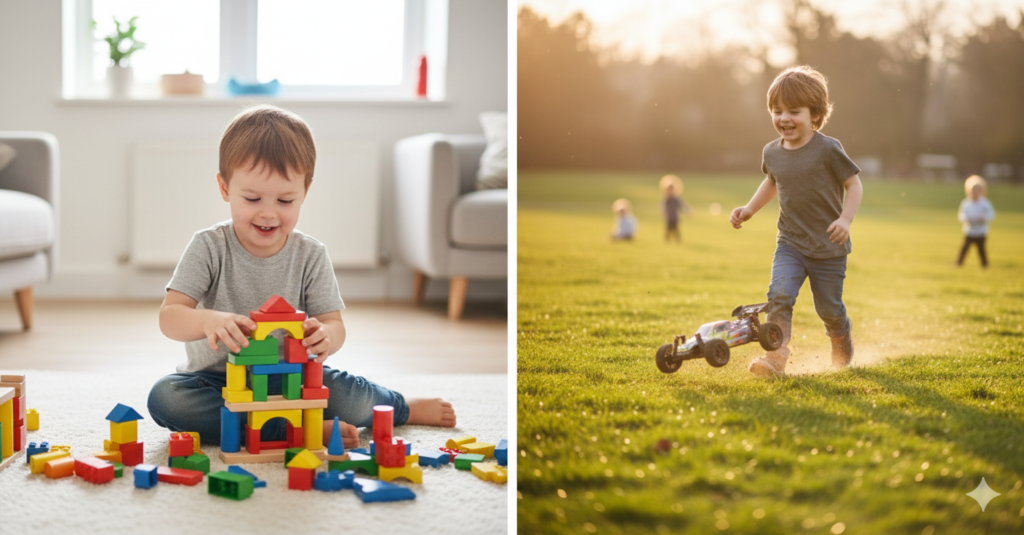
In this article, we’ll compare indoor and outdoor toys, explore their developmental advantages, and offer tips for creating the perfect mix of play experiences.
The Benefits of Indoor Toys
Indoor toys are typically used within the home or other enclosed spaces. These toys are often designed to stimulate creativity, learning, and imagination.
Key Benefits
- Cognitive Development
- Puzzles, building blocks, and educational games enhance problem-solving, memory, and critical thinking.
- Indoor toys allow children to experiment and explore safely, stimulating their intellectual growth.
- Fine Motor Skills
- Toys such as art kits, construction sets, or small manipulatives strengthen hand-eye coordination and dexterity.
- Fine motor skill development is essential for writing, drawing, and other daily tasks.
- Creativity and Imagination
- Role-playing toys like dollhouses, kitchen sets, and plush toys encourage storytelling and imaginative play.
- Open-ended play indoors helps children develop their own narratives and scenarios, fostering creativity.
- Safe and Controlled Environment
- Indoor play minimizes exposure to weather-related risks, traffic, and other outdoor hazards.
- Parents can supervise and guide play more easily, ensuring safety.
The Benefits of Outdoor Toys
Outdoor toys encourage physical activity and exploration, often in open spaces such as parks, gardens, or playgrounds. These toys are designed to promote movement, coordination, and social interaction.
Key Benefits
- Gross Motor Development
- Toys like bicycles, scooters, balls, and RC cars enhance balance, coordination, and overall body strength.
- Physical activity helps children develop larger muscle groups and improves overall health.
- Connection with Nature
- Outdoor play allows children to interact with the natural environment, fostering curiosity and observational skills.
- Exposure to sunlight and fresh air contributes to physical and emotional well-being.
- Social Skills and Teamwork
- Group games and sports teach sharing, cooperation, and problem-solving.
- Outdoor toys provide opportunities for collaboration, healthy competition, and social interaction.
- Stress Relief and Emotional Health
- Running, jumping, and active play release energy and reduce stress.
- Outdoor activities support emotional regulation and overall happiness.
Comparing Indoor and Outdoor Toys
Both indoor and outdoor toys have distinct advantages, and neither is inherently better than the other. Instead, the most effective approach is to combine both types of play to provide a well-rounded experience.
| Feature | Indoor Toys | Outdoor Toys |
|---|---|---|
| Physical Development | Fine motor skills | Gross motor skills |
| Cognitive Growth | Puzzles, problem-solving | Strategic games, active learning |
| Creativity | Imaginative play, arts | Outdoor adventure, exploratory play |
| Social Interaction | Group games indoors | Team sports, cooperative games |
| Safety | Controlled environment | More risk exposure (requires supervision) |
How to Balance Indoor and Outdoor Play
A healthy mix of indoor and outdoor play ensures children benefit from both cognitive and physical development. Here are some practical tips:
1. Schedule Daily Playtime
- Allocate specific times for indoor and outdoor activities.
- Even 30–60 minutes of outdoor play can greatly enhance physical health and brain stimulation.
2. Rotate Toys
- Keep a variety of indoor and outdoor toys accessible.
- Rotate them regularly to maintain interest and encourage diverse skill development.
3. Encourage Creativity in Both Settings
- Indoor creative toys: art kits, building sets, puzzles
- Outdoor creative toys: sand and water play, obstacle courses, nature scavenger hunts
4. Supervise and Guide Play
- Supervision ensures safety, especially outdoors.
- Participation in play can help children learn rules, develop social skills, and enhance problem-solving.
5. Consider Weather and Space
- Indoor play is ideal during bad weather or in limited spaces.
- Outdoor play is excellent for sunny days, open areas, and active games.
Examples of Indoor Toys
- Building blocks and construction sets
- Puzzles and board games
- Art and craft kits
- Dolls and plush toys
- Educational games and learning tools
These toys stimulate intellectual growth, fine motor skills, and imagination.
Examples of Outdoor Toys
- Bicycles, scooters, and ride-on toys
- Balls for soccer, basketball, or catch
- Remote control cars and other active gadgets
- Playhouses, climbing sets, and slides
- Outdoor water and sand play sets
These toys promote physical health, social interaction, and exploratory learning.
Why Both Types of Play Are Important
Combining indoor and outdoor play ensures children develop holistically. Indoor toys nurture cognitive skills, creativity, and fine motor abilities, while outdoor toys strengthen physical health, social skills, and gross motor coordination. Together, they provide a balanced foundation for learning, growth, and emotional well-being.
Additional benefits of balanced play include:
- Enhanced problem-solving abilities
- Improved attention span and focus
- Increased confidence and independence
- Stronger emotional resilience and social competence
Final Thoughts
There is no single “better” type of toy — both indoor and outdoor toys are essential for healthy child development. A balanced approach allows children to grow physically, mentally, socially, and emotionally.
Parents can create an enriching play environment by offering a variety of toys, scheduling daily playtime, supervising appropriately, and encouraging creativity and exploration. Whether it’s an indoor puzzle or an outdoor adventure with a bicycle, every moment of play contributes to a child’s learning, growth, and happiness.